
AI Insights Key Takeaways
- In North Carolina, you generally have 3 years from the date of a crash to file a car accident injury lawsuit, and 2 years from the date of death for a wrongful death claim.
- North Carolina follows pure contributory negligence: if you are found even partly at fault, you can be barred from recovering anything, so what you say to the insurance company matters.
- As of July 1, 2025, North Carolina's minimum auto liability limits are $50,000 per person and $100,000 per accident for bodily injury, plus $50,000 for property damage, along with uninsured/underinsured motorist coverage.
- Schehr Law PLLC handles Charlotte car accident cases on contingency, you pay no attorney fee unless we recover compensation for you.
General information, not legal advice. Every case is different — talk to an attorney about yours.

A car accident on the busy streets of Charlotte can be life-altering. Amid the physical, emotional, and financial strain a crash imposes on you and your family, real help feels like a breath of fresh air. As an experienced car accident lawyer in Charlotte, NC, Schehr Law PLLC supports injured victims through the process of recovering full financial compensation, so you can focus on healing while we handle the claim.
Getting legal help is the easy part. We offer after-hours assistance by phone and email plus 24/7 live call answering, so you can reach us when you need us. Contact us today to start with a free consultation.
Car Accident Injury Claims in Charlotte, NC
Victims injured by another party’s negligence can seek compensation from the at-fault driver or another responsible party. But specific North Carolina laws can affect your ability to recover, so you should consult a Charlotte auto accident attorney as soon as possible after a collision.
North Carolina’s Contributory Negligence Law
North Carolina follows the strict doctrine of contributory negligence: if you are found even partially at fault, you may be barred from recovering any compensation. Insurers know this and often try to shift blame onto the victim to avoid paying. With an experienced attorney building your case, you can prove the other party’s negligence and overcome these tactics. Schehr Law PLLC has a track record of helping clients do exactly that.
North Carolina’s Statute of Limitations
Generally, you have three years from the date of the accident to file suit in North Carolina, though exceptions apply. Missing this deadline can cost you the right to pursue compensation, so it’s essential to talk to an attorney promptly.
Auto Insurance in North Carolina
North Carolina requires all drivers to carry minimum liability coverage. As of July 1, 2025, the state minimums increased to:
- $50,000 in bodily injury coverage for one person per accident
- $100,000 in bodily injury coverage for two or more people per accident
- $50,000 in property damage coverage
- Uninsured (UM) and underinsured (UIM) motorist coverage
The coverage available across all at-fault parties, plus your own UM/UIM coverage, affects your recovery. If you’re hurt by an uninsured or underinsured driver, your own policy may provide compensation that wouldn’t otherwise be available.
Car Accidents in Charlotte: Local Roads, Reports & Courts
Some of the Charlotte area’s most serious crashes happen on its busiest corridors, the I-77 and I-85 interchange, I-485 around the outerbelt, Independence Boulevard (US-74), Billy Graham Parkway, South Boulevard, and W.T. Harris Boulevard. We represent injured drivers and passengers throughout Mecklenburg County, Uptown, South End, University City, Ballantyne, Steele Creek, NoDa, Matthews, Pineville, and Huntersville, and the surrounding counties.
Your crash report. Charlotte-Mecklenburg Police, or the N.C. State Highway Patrol on the interstates, documents the collision in an official crash report. That report, the scene evidence, and your medical records are the foundation of an injury claim, so request a copy and keep everything.
Where your case is handled. Mecklenburg County personal-injury lawsuits are filed at the Mecklenburg County Courthouse, 832 East 4th Street in Uptown Charlotte. A local attorney who knows the county’s courts, and the insurance-defense firms on the other side, is an advantage if your case has to be litigated.
Getting treated. Seriously injured crash victims in Charlotte are often treated at Atrium Health’s Carolinas Medical Center or Novant Health Presbyterian Medical Center. Follow through on all recommended care; gaps in treatment are the first thing an insurer uses to discount a claim.
Types of Car Accidents We Handle
Different collisions raise different questions of fault and cause different injuries. Schehr Law PLLC handles the full range of motor vehicle crashes, including:
Rear-End Collisions
Often caused by distracted driving, sudden stops, or tailgating. Injuries range from whiplash to more severe harm depending on the force of impact.
Side-Impact (T-Bone) Collisions
Common at intersections, where the less-protected side of a vehicle is struck, frequently causing significant injuries.
Head-On Collisions
Among the deadliest crashes, often caused by wrong-way, distracted, or impaired driving. Injuries are frequently catastrophic.
Single-Vehicle, Pile-Ups, Rollovers & Hit-and-Run
Liability in these crashes can be surprisingly complex, from mechanical failures and hazardous roads to chain-reaction highway pile-ups and drivers who flee the scene. Each demands prompt legal attention to identify every responsible party and protect your rights.
We also maintain dedicated resources on the specific crash types we see most across Charlotte: distracted-driving crashes, drunk-driving crashes, highway and interstate crashes, rear-end collisions, and road-construction-zone crashes.
Common Car Accident Injuries
- Whiplash & neck injuries: strained muscles and ligaments, headaches, and chronic or cervical-spine pain
- Back & spinal cord injuries: from strains and herniated discs to paralysis
- Head injuries & TBIs: concussions through severe brain damage, sometimes without a direct blow to the head
- Broken bones & fractures: arms, legs, ribs, and hips, sometimes requiring surgery or long-term rehab
- Internal injuries: internal bleeding and organ damage that can be life-threatening
- Psychological injuries: anxiety, PTSD, and depression that can be as debilitating as physical harm
Common Causes of Charlotte Car Accidents
Most crashes come down to a driver’s choices. Common contributors on North Carolina roads include distracted driving (texting, phones, infotainment screens), impaired driving, speeding and aggressive driving, running red lights and stop signs, drowsy driving, and unsafe maneuvers such as improper lane changes and tailgating. Weather and poor road conditions contribute as well, though a driver is still expected to drive reasonably for the conditions. Pinpointing the true cause, and proving it, is central to your claim.
Damages You Can Recover After a Charlotte Car Accident
North Carolina lets injured victims pursue compensatory damages, money intended to make you whole. They fall into two categories:
Economic damages
- Past and future medical bills, emergency care, surgery, therapy, and long-term treatment
- Lost wages and reduced future earning capacity if you cannot return to the same work
- Property damage, vehicle repair or replacement and related out-of-pocket costs
Non-economic damages
- Pain and suffering and the physical toll of your injuries
- Emotional distress, anxiety, and PTSD
- Loss of consortium for a spouse and loss of the ability to enjoy life
North Carolina caps non-economic damages in medical-malpractice cases (N.C.G.S. § 90-21.19); an ordinary motor-vehicle injury claim is not subject to that malpractice cap. In cases of egregious conduct such as drunk driving, punitive damages may also be available (N.C.G.S. § 1D-26).
How Fault Is Proven Under North Carolina’s Contributory Negligence Rule
Because even 1% of fault can bar your recovery in North Carolina, how fault is established is especially consequential here. A thorough case is built on:
- The crash report and the investigating officer’s findings
- Scene evidence, photos, skid marks, debris fields, and vehicle-damage patterns
- Witness statements and, where available, traffic-camera or business surveillance footage
- Vehicle data, event-data-recorder (“black box”) downloads and, in serious cases, phone records
- Accident reconstruction by qualified experts when liability is disputed
Insurers know the contributory-negligence rule and look for any angle to assign partial blame to you. Building the evidence early, before memories fade and footage is overwritten, is an essential part of what a Charlotte car accident lawyer does.
What to Do After a Car Accident in Charlotte
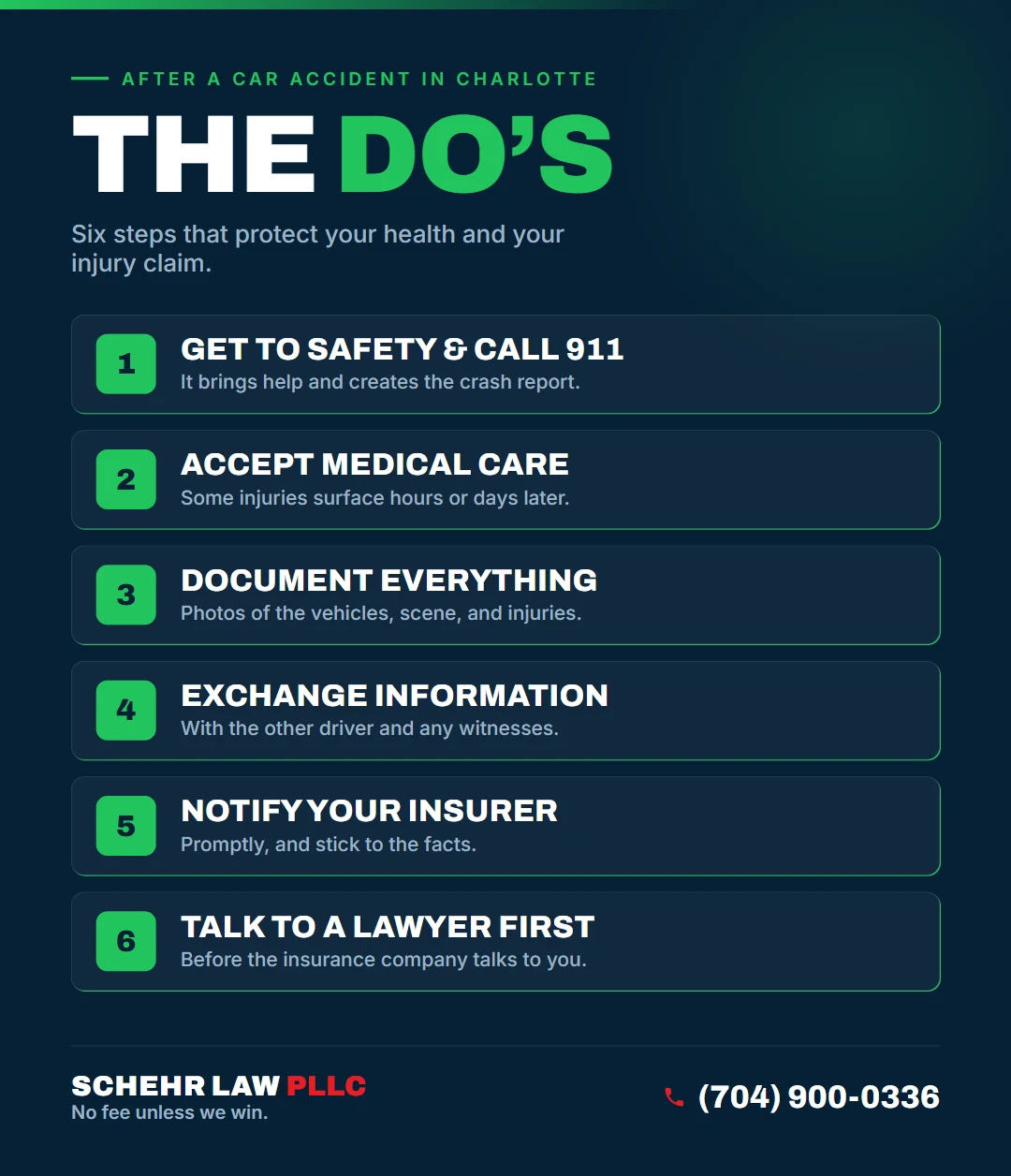
- Get to safety and call 911. Reporting injuries brings officers and EMS and creates an official crash report.
- Accept medical care. Some injuries surface hours or days later, and prompt treatment protects both your health and your claim.
- Document everything. Photograph the vehicles, the scene, road conditions, and any visible injuries.
- Exchange information with the other driver and collect names and numbers of witnesses.
- Notify your own insurer promptly, and stick to the facts.
- Talk to a lawyer before the insurance company talks to you. A free consultation can prevent costly early mistakes.
What Not to Do After a Crash
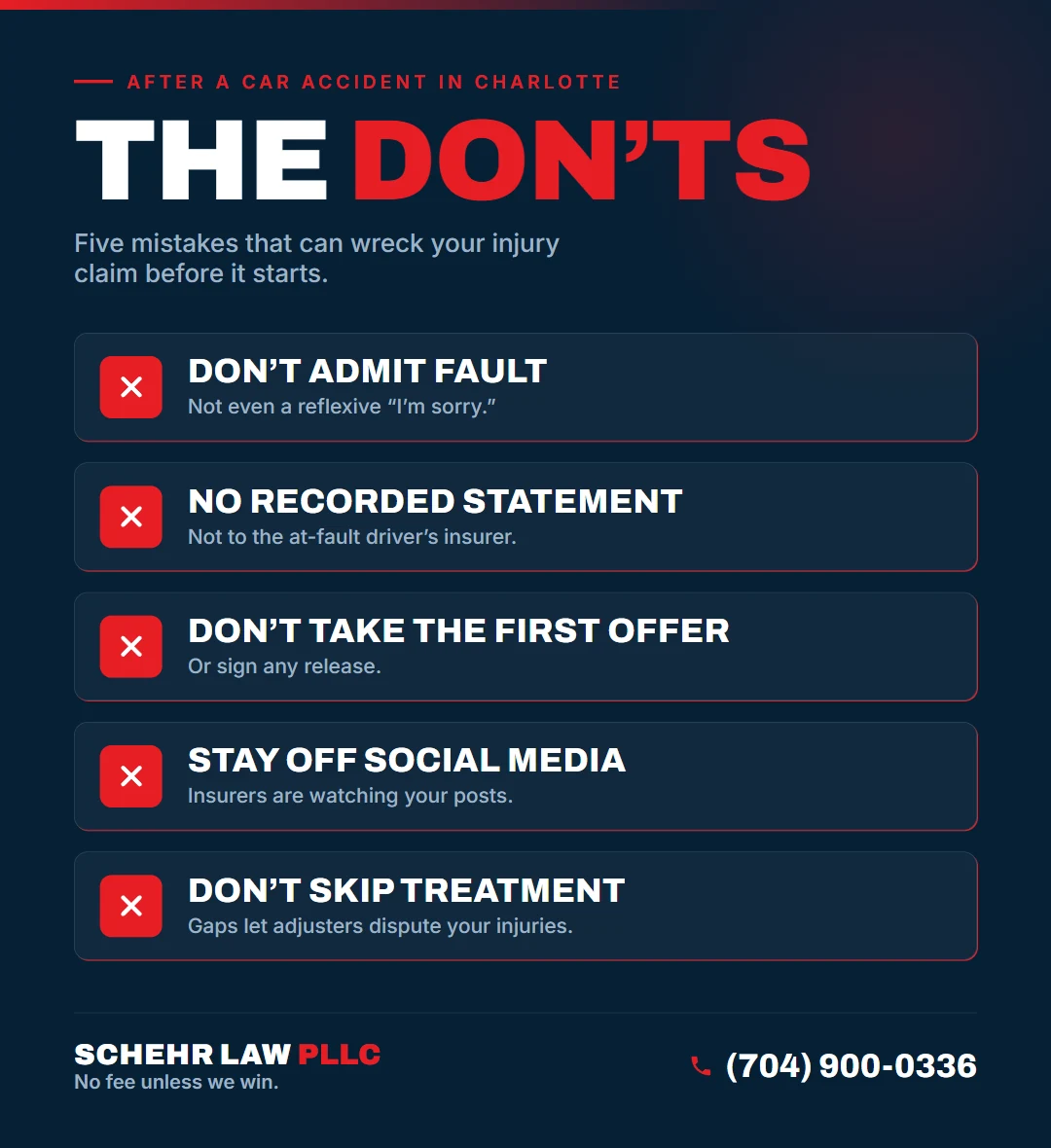
- Don’t admit fault, even a reflexive “I’m sorry.” Under contributory negligence, it can be used to deny your claim.
- Don’t give the at-fault driver’s insurer a recorded statement without speaking to your attorney first; you are generally not required to.
- Don’t accept the first offer or sign a release before your full damages, including future care, have been valued.
- Don’t post about the crash on social media; insurers look, and posts are easily taken out of context.
- Don’t delay or skip treatment; gaps are the first thing an adjuster uses to argue you weren’t badly hurt.
How Car Accident Claims Work, and How Long They Take
After you’re treated and the evidence is gathered, your attorney presents a demand to the insurer and negotiates for a fair settlement. Straightforward claims can resolve in a few months; cases with serious injuries, disputed fault, or a commercial defendant take longer, and some must be filed as a lawsuit to force a fair result. North Carolina does not set a single fixed timetable, but insurers must handle claims reasonably promptly under the state’s Unfair Claim Settlement Practices Act (N.C.G.S. § 58-63-15). Your three-year filing deadline runs in the background the entire time, which is why it is unwise to let an insurer stall indefinitely.
What Does a Charlotte Car Accident Lawyer Cost?
Nothing up front. Schehr Law PLLC handles car accident cases on a contingency fee: our fee is a percentage of what we recover for you, and if we don’t recover compensation, you owe no attorney fee. The initial consultation is always free, so there is no financial risk in learning where you stand.
This article is general information about North Carolina law, not legal advice, and does not create an attorney-client relationship. Laws change and every case is different, for advice about your situation, speak with a licensed attorney. Reviewed by M. Christopher Schehr, Esq. · Last updated October 2026.
How Schehr Law PLLC Can Help
We understand the burdens these injuries impose, and we’ll work tirelessly to recover compensation for your injuries, medical bills, lost wages, and pain and suffering. As your Charlotte auto accident attorney, we’re prepared to:
- Evaluate your case to identify every potential defendant and cause of action
- Investigate and gather evidence of the at-fault motorist’s negligence
- Handle all paperwork, filings, and legal deadlines
- Deal with the insurance company on your behalf
- Negotiate aggressively for a fair settlement, and take your case to trial if needed
Why Choose Schehr Law PLLC
Since attorney M. Christopher Schehr founded the firm in 2020, we’ve recovered more than $10 million for injured clients, including a settlement of more than $800,000 for the victim of a crash involving a DoorDash delivery vehicle. Every case is unique, but our approach is constant: skilled preparation, aggressive representation, and genuine care for the people we serve. You’re never just a number, and you never pay a fee unless we win.
Frequently Asked Questions
What should I do after a car accident?
Assess injuries and move to safety if possible. Call 911, document the scene with photos and notes, exchange information with other drivers, gather witness contacts, and seek medical attention right away. Then consult an experienced Charlotte car accident lawyer about your rights.
How long do I have to file a car accident claim in NC?
Generally three years from the date of injury. If the crash causes a fatality, the representatives have two years from the date of death to file a wrongful death lawsuit. Missing the deadline usually bars the claim.
How long do I have to report the accident to my insurer?
There’s no strict statutory deadline, but report as soon as possible. Most policies require prompt notice, and delay can give the insurer grounds to deny your claim.
How long does an insurer have to settle a claim in NC?
North Carolina doesn’t set a single fixed timetable. Under the state’s Unfair Claim Settlement Practices Act (N.C.G.S. § 58-63-15(11)), insurers must acknowledge and act reasonably promptly on claims, investigate within a reasonable time, and pay a settled claim without undue delay, and unreasonable or repeated delay can itself be an unfair practice. Because timelines depend on the facts and documentation, an attorney can help keep the insurer moving.
What if the insurance company says I’m at fault?
Under North Carolina’s contributory negligence rule, being found even slightly at fault can bar recovery. If the insurer claims you share fault, retain an attorney right away, and don’t argue the point with them directly.
Talk to a Charlotte Car Accident Lawyer Today
Don’t navigate North Carolina’s complex car accident laws alone. The right representation can make all the difference in what you recover, and in the toll the process takes on you. For help, contact us today or call (704) 900-0336.